breaking free from drama
‘how the hell are you so… chill?!’
it’s one of the questions i get asked most. the answer? maybe it’s my baseline enneagram type (i’m a 9 - the peacemaker). maybe it’s my naturally conflict-avoidant self. the real answer though? when i started getting more in-depth with conscious leadership, i gave up on my addiction to drama. and understanding the drama triangle was the key. let’s dive in.
Think of the last time you felt frustrated by a recurring conflict - maybe with a coworker, a friend, or at yet another stressful family gathering.
You walk in hoping for a normal interaction, but somehow, like clockwork, the same tensions flare up. Someone plays the victim. Someone points fingers. Someone rushes in to fix everything. And before you know it, you’re caught in the same old cycle. the conversation never goes as you thought it would. there’s anger, blame, shame, or sadness. understanding this pattern of behavior helped me see my core patterns when drama shows up, and how to move out of drama and into productivity.
the drama triangle: 101
so what are we talking about? First identified by psychologist Stephen Karpman in 1968, the Drama Triangle is a psychological model that helps explain those particularly ‘hairy’ social interactions. when humans get dramatic, they often unconsciously fall into one (or more) of these three archetypal roles:
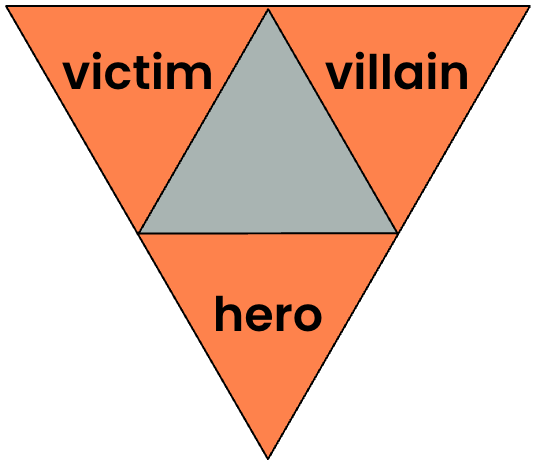
The Victim – “Poor me!” The Victim feels oppressed, helpless, and powerless. the world is happening ‘to them’ and they have no control. They seek sympathy and often believe that external circumstances—or other people—are responsible for their suffering. they’re not interested in finding solutions.
The villain – “It’s all your fault!” The villain is controlling, blaming, and critical. They point fingers, issue ultimatums, and make sure the Victim knows exactly who’s to blame (hint: it’s never them). by blaming others, they shapeshift away from taking responsibility or accountability for their own situation.
The hero – “Let me help you!” The hero swoops in, offering unsolicited advice, fixing problems that aren’t theirs to fix, and generally feeling oh-so-needed. But their help often keeps the Victim dependent and the cycle spinning. key here is that while hero-ing can feel great - i’ve been helpful! - the hero consistently prioritizes short term conflict resolution over long term solutions.
we humans often have a ‘home’ drama type. mine is the hero. i looooove to resolve tensions by suggesting short term solutions. unfortunately, if i’m in the hero mode i loose sight of the longer term fix. i have a family member who consistently operates from the victim role, where they see everything happening to them, with no recourse or way out. and oh man, one of my bosses was a poster child for the villain role - they’d lay out incomplete expectations, then blame me when the work result wasn’t what they expected.
dancing on the triangle
Here’s the tricky part: these roles aren’t fixed. People switch between them all the time.
A hero, frustrated that their help isn’t working, might become a villain, exclaiming “Why aren’t you even trying?!” A Victim, tired of being blamed, might lash out and take on the villain role. Even the villain, feeling guilty, can slip into hero mode.
and it gets even more complex when we step away from what’s happening for us, and include someone else on the triangle. what does every hero need? a a villain to challenge. what turns on a villain? the existence of a victim. and what does a victim believe they need? hello, hero!
break free from the drama
so, you’ve spotted yourself on the triangle… what next?
Notice when you're in it.
Are you feeling victimized? like the whole world is against you?
Are you pointing fingers instead of problem-solving? blame game much?
Are you jumping in to save the day? maybe because its… uncomfortable?
Shift from Drama to Empowerment. (based on the work of Dave emerald)
The Victim becomes the Creator, focusing on solutions.
The villain shifts to Challenger, encouraging growth without blame.
The hero turns into Coach, offering support without enabling.
Check your boundaries.
You’re not responsible for fixing everyone.
You don’t have to accept blame that isn’t yours.
You can choose not to engage in drama-driven dynamics.
Communicate with clarity. Instead of reacting emotionally, ask yourself:
“What’s my role here? How can I respond in a way that empowers rather than escalates?”
Breaking free from the Drama Triangle doesn’t mean you’ll never feel like a Victim, get annoyed like a villain, or want to help like a hero. But recognizing the game and choosing a different response? That’s where the real power lies.
So, the next time you find yourself in a dramatic situation, ask:
"Do I want to stay in this cycle, or is it time to rewrite the script?"
The choice is yours. thanks for being here.

interested in learning more about the drama triangle or conscious leadership? reach out!
